
The History of Union Station
Union Station Toronto is Canada's busiest public transportation structure, located at 65 Front Street West in downtown Toronto, at the block bounded by Bay Street, York Street, and Front Street West. Toronto Union Station serves 65 million passengers annually, connecting GO Transit, VIA Rail, the UP Express, the TTC subway, streetcar lines, and Ontario Northland services in a single station building that has anchored the southernmost part of the city's downtown core for nearly a century.
Toronto Union Station is a designated National Historic Site of Canada, recognized for both its scale and its architecture. The current station building, with its monumental colonnade of 22 Bedford limestone columns, has 23 platforms serving train services, and connects directly to the PATH, the world's largest underground pedestrian network.
Union Station's history dates back to 1858, when earlier structures first served Toronto's rail passengers on this site. Toronto's previous Union Stations were operational from 1855 and 1873, before the current station replaced them. Construction of the current Union Station began around 1914, and the station officially opened on August 6, 1927, at a time when it served over 300,000 travelers daily.
Union Station was designated a National Historic Site of Canada in 1975, cementing its status as one of the country's most significant heritage railway stations. The building's architects — G.A. Ross, R.H. Macdonald, Hugh Jones, and John M. Lyle — designed a Beaux-Arts landmark whose Great Hall remains one of the finest examples of early 20th-century railway architecture in Canada. Union Station has also become a popular filming location for major movies, thanks to its grand interiors and instantly recognizable exterior.
Architecture and the Great Hall
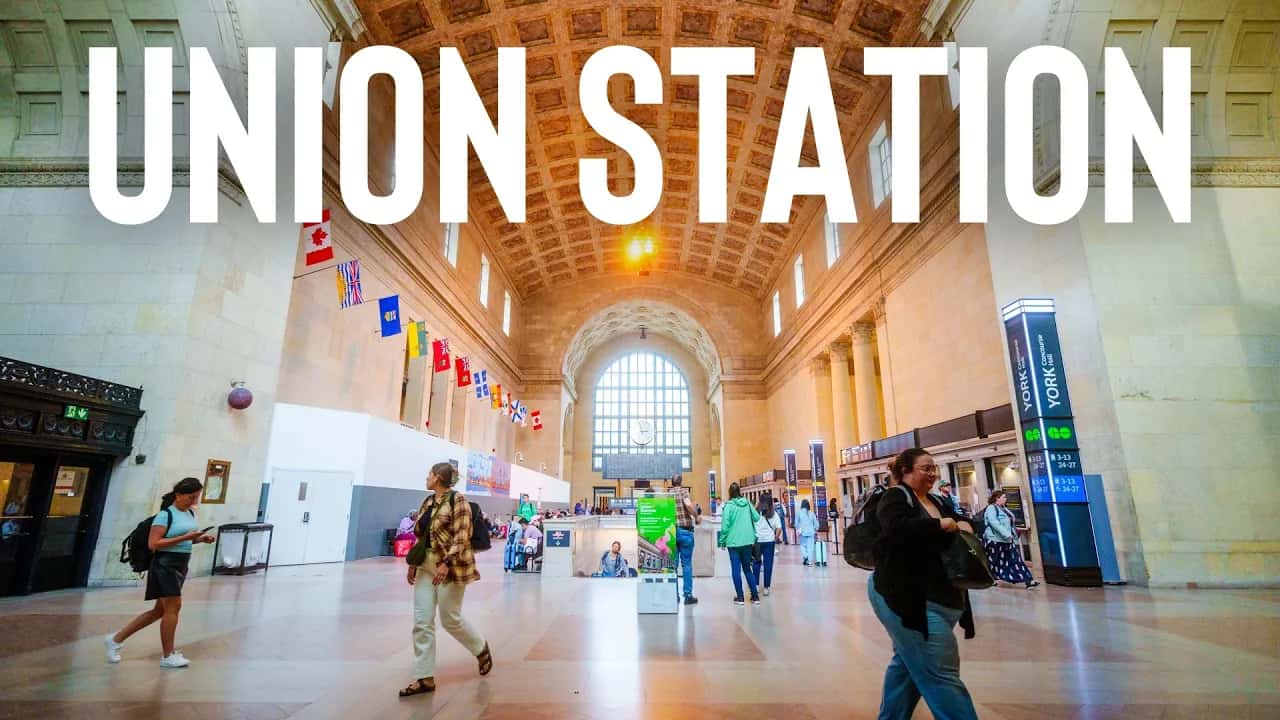
The Great Hall at Union Station features a vaulted ceiling reaching 27 meters high, framed by the station's signature Bedford limestone columns. The exterior of Union Station features a monumental colonnade facing Front Street West, one of the most photographed views of any train station in Canada.
Toronto Union Station underwent a multi-year revitalization project in the early 2020s, modernizing the station while preserving its historic character. As part of the union station project, the Bay Concourse reopened on July 27, 2021, after expanding from 40,000 to over 60,000 square feet. The York Concourse, a separate space within the station, measures 62,000 square feet and serves as another major circulation point for rail passengers moving through the building.
A new southern entrance opened in 2010, adding a new south concourse to the station's layout, while the train shed renovation began in January 2010, well ahead of the later concourse work. Today, the station's new bay concourse and expanded south concourse work together to move large volumes of passengers efficiently, even at peak demand.
Address
ON M5J 1E6, Toronto, Canada
Popular questions
The UP Express train provides a direct 25-minute link between Toronto Union Station and Pearson International Airport, connecting easily with the TTC subway at Union Station.
Toronto Union Station connects passengers to GO Transit regional trains and buses, VIA Rail national passenger services, the UP Express airport link, TTC subway, streetcar and bus connections, and Ontario Northland services to northeastern Ontario — making it Canada's largest and busiest multi-modal transit hub, serving over 300,000 passengers daily.
Toronto Union Station's official hours are 5:30 AM to 12:45 AM daily. Luggage storage is available through Bounce and BagsAway, which provide secure options near the station.
Yes, Union Station Toronto was designated a National Historic Site of Canada in 1975, recognizing both the heritage railway station's architecture and its central role in the country's rail history.
Toronto Union Station is located at 65 Front Street West, in the block bounded by Bay Street, York Street, and Front Street West in downtown Toronto.
The station building at Union Station is known for its monumental colonnade of 22 Bedford limestone columns and the Great Hall's vaulted ceiling, which reaches 27 meters high — making it one of the finest examples of early 20th-century railway architecture in Canada.
The Bay Concourse is one of Union Station's main circulation spaces, reopened on July 27, 2021, as part of the station's revitalization project, after expanding from 40,000 to over 60,000 square feet to handle growing passenger demand.
The train shed at Union Station covers the platforms where passengers board GO Transit, VIA Rail, and other services. The train shed renovation began in January 2010, well before the later concourse upgrades, helping modernize the platforms beneath the historic station building.
Union Station sits at 65 Front Street West, with its main entrance and monumental colonnade facing Front Street West directly, making it one of the most recognizable buildings along that stretch of downtown Toronto.
Yes, Ontario Northland operates passenger services from Union Station, connecting Toronto to communities across northeastern Ontario alongside GO Transit, VIA Rail, and the UP Express.
Yes, Toronto Union Station is open daily from 5:30 AM to 12:45 AM, with train, subway, and streetcar connections available throughout its operating hours.
Union Station sits on the block bounded by Bay and York Streets and Front Street West, in downtown Toronto. The main entrance faces Front Street West, with Bay Street to one side and York Street to the other, making it easy to walk to the station from almost any direction downtown.
Yes, historically the Canadian Pacific Railway was one of the railways that used Toronto Union Station alongside Canadian National, reflecting the station's long-standing role as a shared, multi-operator hub rather than a single-railway terminal.
Amtrak's Maple Leaf service connects Toronto Union Station to New York City, operated jointly with VIA Rail. There is currently no direct Amtrak train from Toronto Union Station to Chicago; a route once linked the two cities, but that particular Chicago connection is no longer in operation today.
Many people visit Union Station simply to see the Great Hall and its architecture, even without a train to catch. If you plan a visit, walking through the Great Hall and the Bay Concourse gives a good sense of the station's scale, and it's an easy stop if you're already exploring downtown Toronto on foot.
Yes, several parking facilities are available near Toronto Union Station for travelers arriving by car, though many passengers instead rely on GO Transit, the TTC, or streetcar lines to reach the station without needing parking at all.
Union Station functions as more than a train terminal — it's a full multi-modal hub connecting GO Transit buses, the TTC subway, and streetcar lines alongside its train platforms, so it's not just a rail terminal in the traditional sense.
Yes, tickets for GO Transit, VIA Rail, and the UP Express can generally be purchased online in advance, and ticket vending machines are also available inside the station concourses for anyone who prefers to buy tickets on the day of travel.
Union Station is designed to be accessible throughout, with a wheelchair lift, accessible routes between concourses, and staff assistance available for passengers who need it. Accessible features extend across the Bay Concourse, York Concourse, and train platforms, reflecting the station's effort to remain accessible to all customers regardless of the volume of passengers passing through on a given day.
With 23 platforms and multiple concourses, Union Station is built to manage very high customer demand, especially during peak commuting hours. Ongoing construction and upgrades over the years have focused on keeping the flow of customers and passengers moving efficiently between train platforms, the subway line, and street-level exits.
The York Concourse is one of Union Station's key circulation spaces, connecting passengers between train platforms, the subway, and street-level exits. Along with the Bay Concourse, the York Concourse helps distribute the large volume of customers moving through the station at any given time.
Timing for the last train from Union Station depends on the specific GO Transit, VIA Rail, or UP Express line you're travelling on, so it's worth checking the schedule for your particular service in advance, especially on GO Transit lines with reduced late-night frequency.
Union Station is easily reached on foot from the surrounding downtown streets, including Bay Street, York Street, and Front Street West, with the main entrance and PATH access points both offering direct access into the station without needing to cross traffic at street level.
Ticket counters and digital boards throughout Union Station display live platform assignments for GO Transit, VIA Rail, Amtrak, and UP Express services, along with service updates for each platform. Tickets for most services can be checked online in advance, and additional online resources list which platform each train departs from, helping located passengers move quickly between the concourse and their platform without confusion, no matter where in the city they started their journey that day.
Yes, customer assistance is available at multiple points throughout the station, including near the accessible entrances and along Front Street West Toronto and Street West Toronto approaches to the building. Staff can help customers locate the right platform, confirm ticket validity, and provide directions to nearby parking, the Union Pearson Express counter, or connecting services elsewhere in the city.
One more note for planning your trip: Amtrak, GO Transit, VIA Rail, and UP Express tickets can each be checked and purchased through their own ticket systems, so it's worth confirming your tickets and any assistance you might need — such as accessible boarding or extra luggage help — before you arrive, particularly if parking near the station is part of your plan and construction work is affecting a specific entrance or location that week. Location signage throughout the concourse also helps travelers with connecting tickets find the correct assistance desk without confusion. Customers arriving by car should confirm parking availability ahead of time, since parking near a busy customer hub like Union Station can fill up quickly, and customers switching between tickets for different operators may need to visit more than one counter to sort out their tickets before boarding, especially when connecting tickets from GO Transit customers need validating against VIA Rail or Amtrak tickets for the same journey.
Union Station has a total of 23 platforms serving train services, supporting a wide mix of operators. GO Transit handled approximately 69.5 million passengers in 2015 alone, using Union Station as its central hub for regional trains and buses across the Greater Toronto Area. VIA Rail operates national passenger rail services from the station, connecting Toronto to major cities across Canada.
The Union Pearson Express (UP Express) connects Union Station directly to Toronto Pearson Airport, with a dedicated customer service counter for UP Express passengers inside the station. Ontario Northland also operates services from Union Station, linking Toronto to communities in northeastern Ontario. Ticket vending machines are located throughout the concourses for GO Transit, VIA Rail, and UP Express tickets, and TTC station access connects rail passengers directly to Toronto's subway network and streetcar lines.
Toronto Union Station sits at 65 Front Street West, bounded by Bay Street and York Street, on Front Street West in the heart of downtown Toronto. The main entrance faces Front Street West, while the south side of the building connects to the new south concourse and the PATH pedestrian network below.
The station is open daily, with wheelchair lift access and other accessible routes available for passengers who need them, and assistance is available throughout the station for anyone requiring extra support. Luggage storage options are available nearby for travelers who want to explore downtown Toronto before catching their last train home.