
Everything You Need to Know About Greece Train Travel
Greece trains are one of the best ways to explore the Greek mainland — passing through olive groves, river gorges, coastal plains, and mountain landscapes that few other forms of travel reveal so vividly. Whether you're travelling between Athens and Thessaloniki on an express service, exploring smaller towns and villages along the way, or connecting with ferry services at a port for onward travel to the Greek islands, trains in Greece combine practicality with a genuinely unique experience of the country.
The Greece rail network connects Athens with Thessaloniki — the two largest cities on the mainland — on the main corridor running north through the heart of the country, passing through Larissa and close to Mount Olympus before arriving in the north. Intercity services cover this corridor with journey times of around 5 hours on upgraded track. Beyond the capital, the network extends to Patras in the Peloponnese, to Volos and Kalambaka in central Greece, and toward Eastern Macedonia and the Bulgarian border. A suburban railway connects Athens with its airport and the port of Piraeus, running as part of the wider urban transport network around the capital.
Greece trains cannot reach the Greek islands directly — for island travel, passengers take a ferry from port towns on the mainland. The train and ferry combination is popular with travellers exploring both the mainland and the islands in a single trip, with rail connecting to ports for onward ferry departures. All Greece train tickets can be booked in advance through HighSpeedTrains.
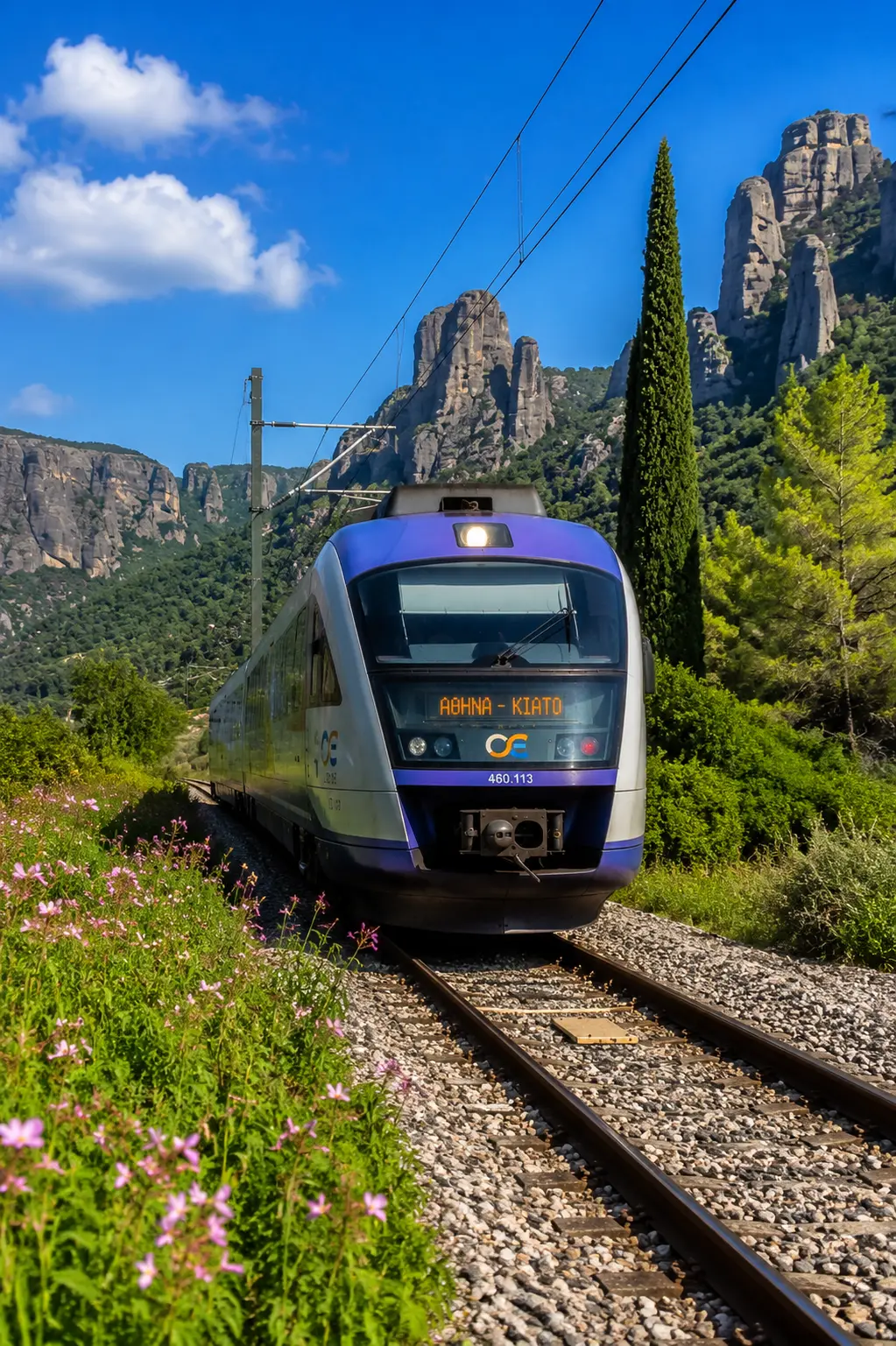

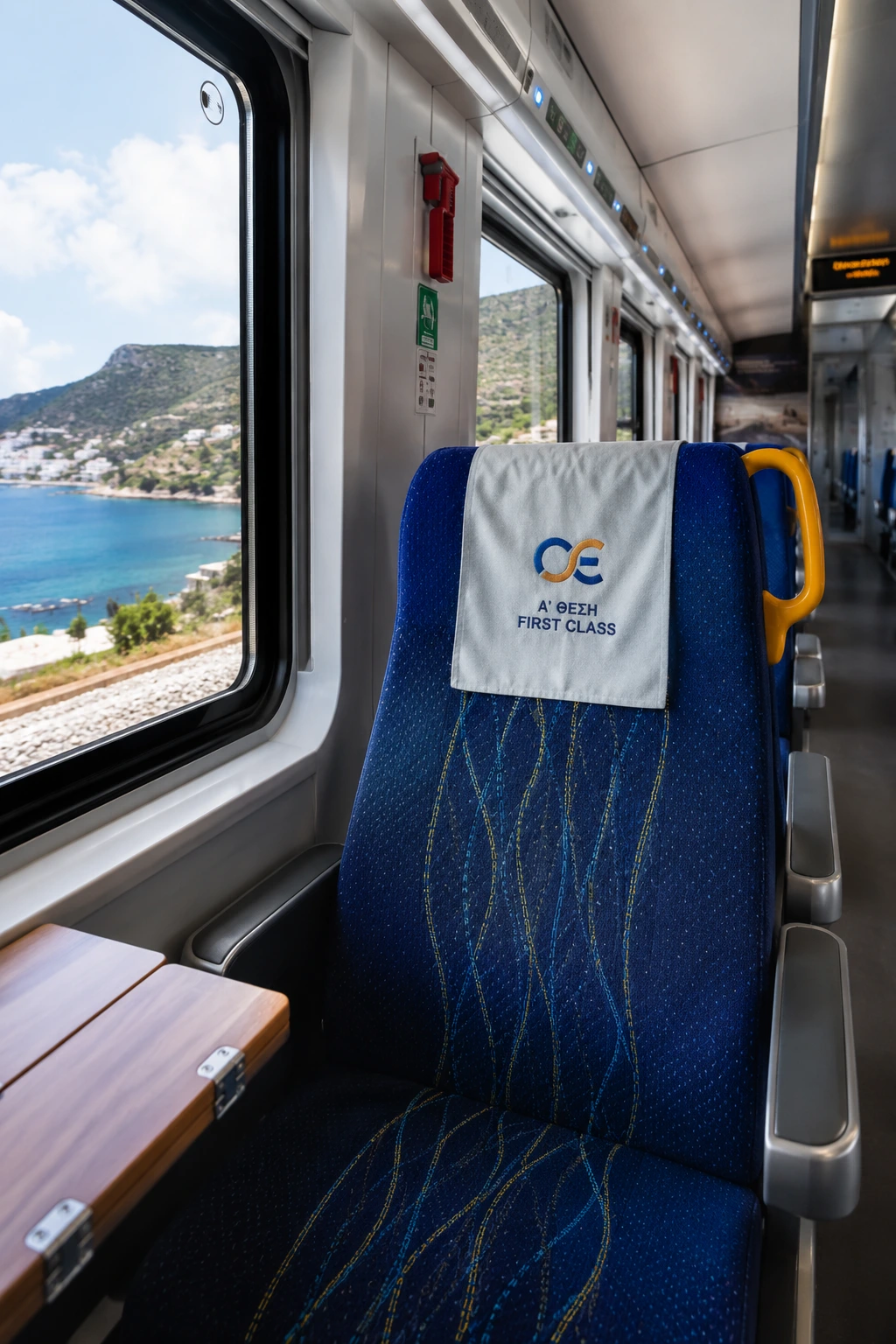
Athens Thessaloniki — Greece Rail's Main Intercity Route

The Athens to Thessaloniki corridor is the backbone of Greece rail and the most important route for passenger travel in the country. Running approximately 507 km between the two cities, the line passes through the Thessaly plains, the Vale of Tempe, and the eastern foothills of Mount Olympus — one of the most scenic rail journeys in southern Europe. Hellenic Train operates express intercity trains on this corridor at speeds of up to 200 km/h on upgraded sections, with a journey time of around 5 hours making it a competitive alternative to domestic flights on the same route.
Trains on the Athens and Thessaloniki corridor offer comfortable seating in both first class and standard class, with air conditioning, a restaurant car on most departures, and power sockets on newer rolling stock. Reservations are strongly recommended on all intercity services, particularly during peak travel periods and public holidays when trains fill quickly. The timetable offers several departures per day in each direction — check the current timetable and book tickets for Athens to Thessaloniki and Thessaloniki to Athens through HighSpeedTrains.
Beyond the Athens Thessaloniki corridor, intercity trains also serve Larissa and Volos, while regional trains connect smaller towns and stations across central Greece and Eastern Macedonia. Upgrade projects are ongoing across the network, with construction aimed at reducing journey times and expanding capacity expected to be completed in the coming years.
The Greek Railway System — Regional Trains and the Steam Train Unique Experience

Regional trains serve destinations across the Greek mainland beyond the intercity corridor, connecting cities, towns, and villages along lines that offer a closer view of the Greek countryside — passing through agricultural landscapes, river valleys, and historic towns past which faster services travel without stopping. These trains are essential for reaching smaller stations and destinations off the main line, and are well integrated with intercity services at major interchanges. Reservations are not always required on regional services, though booking in advance through HighSpeedTrains is advisable.
A suburban railway operates around Athens, connecting the city's central railway station at Larissa with Athens International Airport, the port of Piraeus, and surrounding suburbs. This makes arrival by plane or ferry straightforward — passengers step off their flight or ferry and connect directly with the wider rail network from a nearby train station without needing a taxi or bus. The line runs frequently throughout the day and interchanges with the Athens metro at several stations across the city, making it easy to reach the city centre or onward rail connections from the point of arrival.
Greece also has a remarkable narrow-gauge steam train route that offers a unique experience of the country's rail heritage — one that travellers from London, across Europe, and further afield come specifically to ride. The Diakofto–Kalavryta rack-and-pinion railway in the Peloponnese climbs through the Vouraikos Gorge on a narrow-gauge track that clings to the cliff face, rising over 700 metres in just 22 km. This steam train is a destination in itself, reachable from Athens by mainline train to Diakofto in the south, and one of the most extraordinary rail journeys in the world.
Popular questions
Greece trains fall into several categories. Intercity express trains are the fastest passenger services, connecting Athens and Thessaloniki at up to 200 km/h. Regional trains serve smaller cities and stations across the mainland. A suburban railway connects Athens with its airport, the port of Piraeus, and surrounding suburbs. Hellenic Train is the primary operator across all these railway services. A narrow-gauge steam train also operates on the famous Diakofto–Kalavryta rack railway in the Peloponnese, offering a unique experience quite unlike any other rail journey in the country. All mainstream Greece train tickets can be booked through HighSpeedTrains.
The easiest way to buy train tickets for Greece is to book online in advance through HighSpeedTrains. You'll receive an instant e-ticket, select your preferred seat, and avoid queuing at the station. Booking ahead is particularly important on intercity services between Athens and Thessaloniki, where reservations fill up during peak periods and public holidays. Tickets are also available at station counters and machines, but online booking gives you the widest choice of departure times and class options for your trip.
Reservations are strongly recommended on all intercity trains in Greece, including services on the Athens Thessaloniki corridor. Popular departures fill up quickly and travelling without a reserved seat is not advisable on busier routes. On regional trains and suburban railway services, reservations are generally not required.
Greece trains do not extend to the Greek islands — the islands are accessible by ferry from port towns on the mainland. The suburban railway connects Athens directly with Piraeus, the main departure point for ferries to many Greek islands including Crete, Mykonos, Santorini, and Rhodes. A train and ferry combination is a practical and sustainable way to reach island destinations, saving money on taxis and transfers and making the most of rail connections to ports across the mainland. It's worth spending a little time planning your connection at the point of arrival to make sure your train and ferry timings align.
Yes — Eurail passes are valid on Hellenic Train railway services across the Greek rail network, including intercity trains on the Athens Thessaloniki corridor and regional trains serving other stations on the mainland. Reservations on intercity services are still required separately even with Eurail passes. Greece is included on the Eurail global pass and on country-specific pass options, making it straightforward to combine Greek rail travel with journeys to other countries. Eurail passes can represent excellent value.
The journey time between Athens and Thessaloniki is approximately 5 hours on the fastest intercity express, covering 507 km along the upgraded corridor. The route passes through Larissa and close to Mount Olympus, offering some of the most scenic sights in Greece along the way. Several departures run in each direction daily — check the current timetable and book your ticket in advance through HighSpeedTrains to secure your preferred seat and departure.
Greece has limited international train connections to other countries, though railway services operate toward Bulgaria and North Macedonia from Thessaloniki. From there, connections are available toward Sofia and onward into central Europe, though journey times are long. For travel between Greece and countries like Italy, the UK, or Spain, most travellers combine Greece rail travel with ferry services — taking a ferry from Greek ports such as Patras or Igoumenitsa to Italy, then continuing by rail across Europe. Cars can also be carried on some ferry crossings, making this a flexible option for longer European road and rail trips.
Wi-Fi is available on some intercity trains operated by Hellenic Train, though connectivity varies by route and rolling stock. Newer carriages on the Athens Thessaloniki corridor are better equipped than older regional trains, and power sockets are available on most intercity departures. Regional trains and suburban services may not always offer Wi-Fi depending on the train station and line in operation. Check onboard amenities for your specific departure at the time of booking through HighSpeedTrains.
Train frequency varies significantly by route. The Athens Thessaloniki corridor has several intercity departures per day in each direction. Regional trains connecting smaller towns and stations operate less frequently, often with only a handful of departures per day. The suburban railway around Athens runs much more frequently, with services every 15 to 30 minutes throughout the day. Some lines in more rural areas of Greece operate with limited timetables, so it is worth checking the current schedule before you travel.
The Diakofto–Kalavryta railway is one of the most extraordinary steam train routes in the world — a narrow-gauge rack-and-pinion line that climbs through the dramatic Vouraikos Gorge in the Peloponnese, rising over 700 metres in just 22 km of track. Its terminus at Kalavryta is a mountain town with its own rich history and sights worth exploring after arrival. The route passes through tunnels, over bridges, and along cliff faces, with the gorge falling away below — a unique experience quite unlike anything on the mainline Greek railway system. It connects the coastal town of Diakofto — reachable from Athens by intercity train — with Kalavryta in the south. The journey takes around 45 minutes each way and is one of the most memorable rail trips in Europe.
Yes — travelling by train across the Greek mainland is faster, more comfortable, and more environmentally friendly than travelling by car or bus on most major routes. On the Athens Thessaloniki corridor, intercity trains reach speeds of up to 200 km/h, making them significantly quicker than driving the same distance. Buses serve some destinations not covered by rail, but for the main cities and stations along the central corridor, trains are the preferred option for most travellers. Cars can be useful for exploring rural areas and villages off the rail network, but for city-to-city travel the train is the most efficient and practical choice. Book your Greece rail tickets and check the timetable through HighSpeedTrains.
Eurail passes give travellers the flexibility to travel across Greece and other European countries without buying individual tickets for every journey. A global Eurail pass covers Greece alongside countries including Italy, Spain, and the UK — making it a practical option for travellers planning a broader European rail trip that creates a multi-country itinerary including Greece. A Greece one-country pass covers Hellenic Train railway services across the mainland network. In both cases, reservations on intercity services must be booked separately. The pass itself is available for various lengths of travel and can represent strong value for those spending time on multiple rail journeys across the country and beyond.